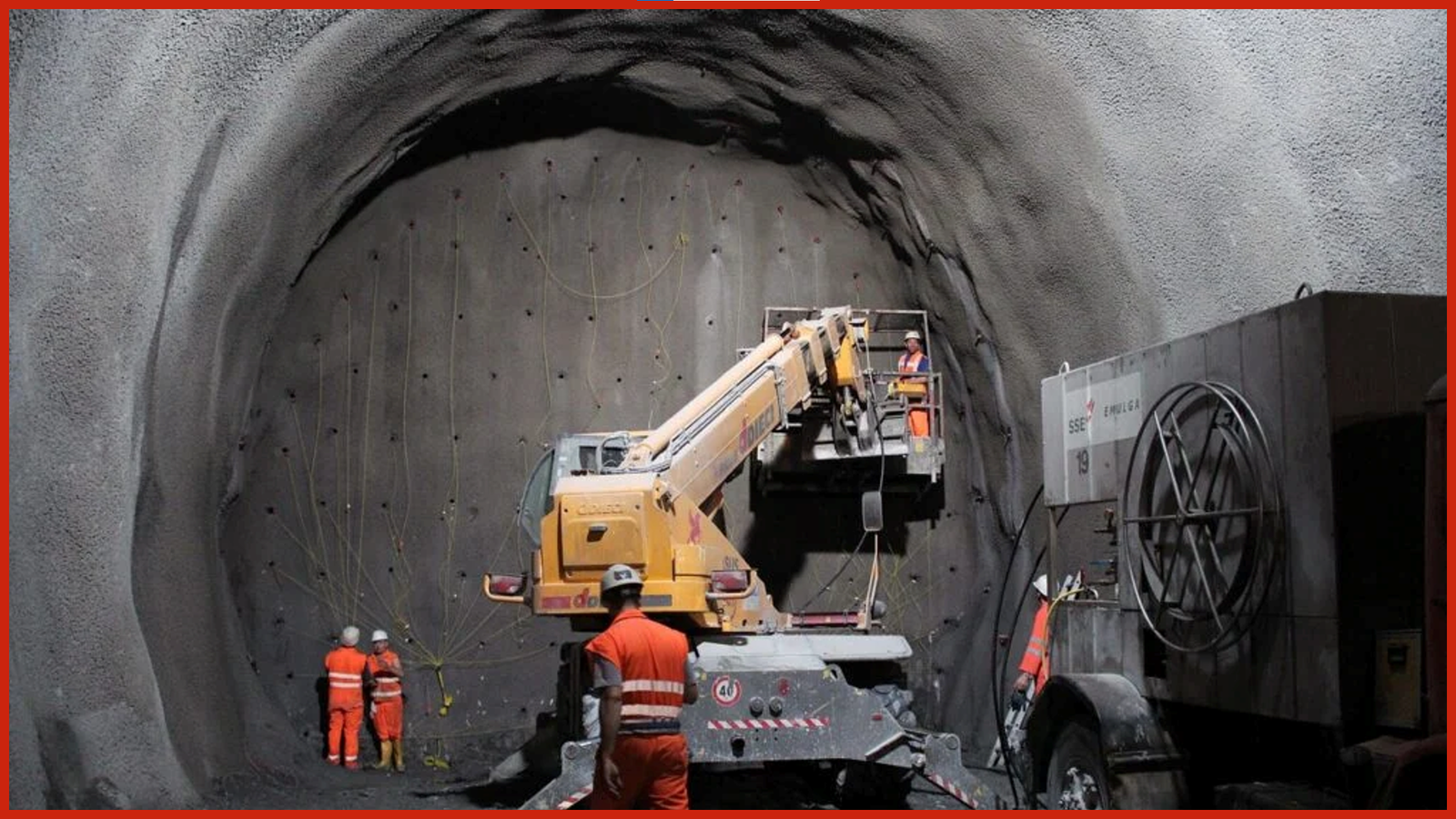
If you’ve searched for shotcrete, shotcrete concrete, or even variations like shortcrete, shotcreet, or shotconcrete (common misspellings you’ll find across construction forums), you’re not alone. Interest in this technique has surged as more engineers and contractors discover how dramatically it can simplify complex builds. This guide covers everything — what shotcrete is, how the shotcrete process works, the real differences in the shotcrete vs. concrete debate, and where the technology is heading next.
Table of Contents
What Is Shotcrete? Understanding the Basics
Shotcrete is a method of placing concrete by pneumatically projecting it at high velocity through a hose directly onto a surface. Instead of being poured into formwork like conventional concrete, shotcrete is sprayed — which means it can adhere to vertical walls, curved shapes, overhead surfaces, and even irregular rock faces without the need for traditional molds.
The term shotcrete meaning is sometimes confused with simply “sprayed concrete,” but the process is more precise than that. The high-velocity impact actually compacts the material as it lands, creating a dense bond with the substrate that can match — and in many cases exceed — the strength of poured concrete. This is what makes shotcrete construction so valuable in challenging environments.
People searching for what is shotcrete often land on guides noting that the technique has been used in tunneling for decades, though it’s now standard in swimming pool construction, slope stabilization, structural repair, and architectural concrete work.
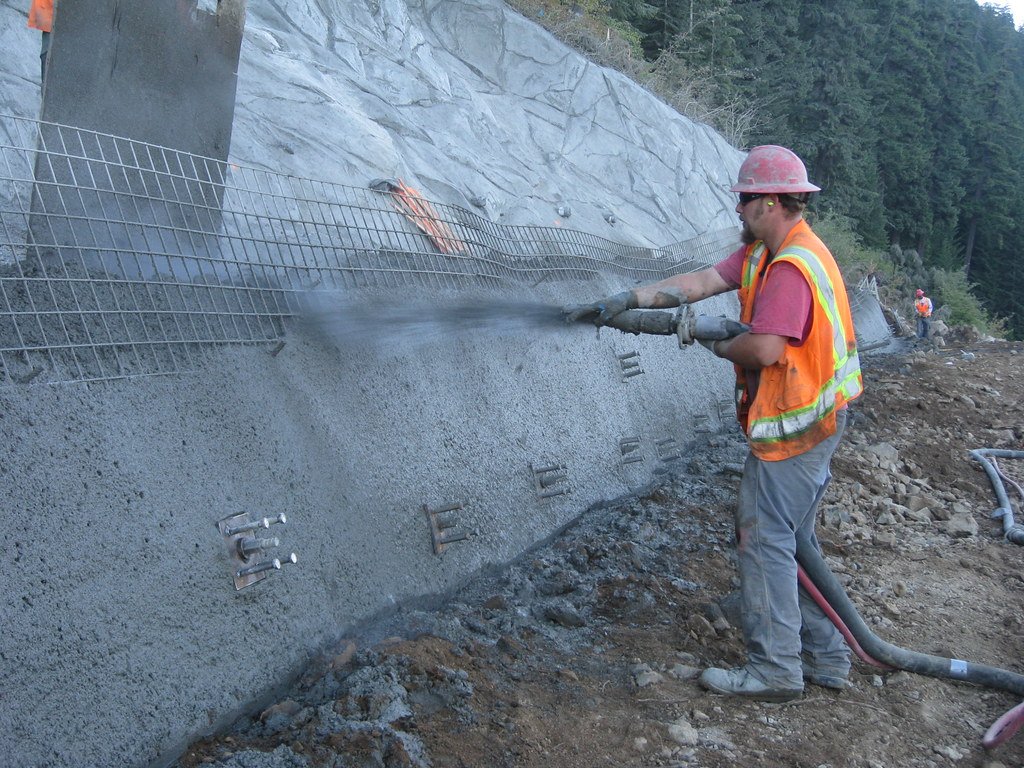
Fig: Application of Shotcrete at site.
Shotcrete vs. Concrete: What’s the Real Difference?
The core difference between shotcrete and concrete isn’t in the material itself — it’s in the delivery method. Both use cement, aggregates, water, and admixtures. The distinction lies in how the mix reaches its final resting place.
In traditional poured (cast-in-place) concrete construction, workers pour the mix into pre-built formwork, then strike it off and allow it to cure. This works well for flat slabs, foundations, and standardized structural elements, but it becomes cumbersome when dealing with complex geometries or remote locations.
Shotcrete eliminates much of that formwork. The mix is projected onto the surface, bonds immediately, and stiffens quickly — especially with the addition of accelerating admixtures. For contractors working on tunnel linings, swimming pools, or retaining walls, the shotcrete application process saves significant time and labor.
That said, concrete vs. shotcrete isn’t always a straightforward win for one side. Poured concrete offers a reliably smooth finish and suits large horizontal surfaces well. The smarter question is: which method fits the geometry, the timeline, and the site constraints of your specific project?
Wet-Mix vs. Dry-Mix (Gunite): Which Shotcreting Method Is Right?
There are two main approaches to shotcreting, and understanding them is key to making the right choice.
Wet-Mix Shotcrete pre-blends all ingredients — cement, aggregates, water, and any admixtures — before pumping the mix to the nozzle. At the nozzle, compressed air projects the mix onto the surface. This method is consistent, high-volume, and well-suited for large infrastructure projects like tunnels, dams, and bridges. Wet-mix shotcrete is also gaining ground in commercial swimming pool construction for its speed and mix reliability.
Dry-Mix Shotcrete (Gunite) feeds dry materials through the hose, with water introduced only at the nozzle by a skilled operator called a nozzleman. This gives the operator real-time control over water content, which can be an advantage for intricate or small-scale work. Gunite has traditionally dominated the residential pool market for exactly this reason. However, the dry-mix approach produces more rebound — wasted material that bounces off the surface — and demands a highly experienced nozzleman to maintain consistent quality.
How Does Shotcrete Work? A Step-by-Step Breakdown
Understanding the shotcrete process helps clarify why it performs so well in difficult applications.
1. Surface Preparation Before any material is placed, the target surface must be clean, rough, and free of dust, oils, and any loose particles. For structural applications — a shotcrete wall, a tunnel lining, or a retaining structure — reinforcing steel or mesh is secured in place first to improve tensile performance.
2. Mixing For wet-mix, the full batch is prepared in a mixing plant or truck and pumped to the nozzle. For dry-mix, the dry materials travel through the hose and water is added at the point of application. Either way, the mix must be carefully proportioned. A typical high-performance wet-mix shotcrete targeting around 48 MPa compressive strength uses roughly 400 kg of cement per cubic metre, supplemented with silica fume, fine and coarse aggregates, water-reducing admixtures, and a superplasticizer.
3. Application The nozzleman directs the jet of shotcrete onto the prepared surface. The material compacts on impact, filling voids and bonding tightly to the substrate. For thicker builds, the material is applied in layers — called lifts — with each layer allowed to stiffen before the next is added. The nozzleman controls angle, distance, and velocity throughout.
4. Finishing and Curing After placement, surfaces can be hand-finished or left textured for additional layers. Curing is critical: water spraying, curing compounds, or moisture-retaining covers are used to allow the concrete to develop full strength. Accelerators help speed up setting when working in cold conditions or on overhead surfaces.
Shotcrete Equipment: From Pumps to Robotic Arms
Modern shotcrete construction relies on increasingly sophisticated equipment.
For wet-mix operations, piston or rotor pumps (from manufacturers like Putzmeister or Sika) handle large-volume delivery reliably. Dry-mix rigs — consisting of a material hopper, a rotary gun, and an air compressor — are more portable and suited for repairs or smaller scopes.
Perhaps the most significant evolution in shotcreting equipment is the rise of robotic shotcrete arms. Mounted on crawler units or tunnel boring machines, these remotely operated systems apply material with high precision in hazardous environments — mines, deep tunnels, confined spaces — reducing risk to workers while maintaining consistent coverage. Integration with AI and LiDAR technology is now enabling real-time surface profiling and quality feedback during application.
Admixture pumps are another key component, injecting accelerators, steel or synthetic fibers, silica fume, or fly ash into the mix at controlled rates — all managed by computer to ensure dosage consistency across the full pour.
Key Applications of Shotcrete Construction
Swimming Pools Both gunite and shotcrete are standard in custom pool construction, valued for their ability to hold free-form shapes that poured concrete simply can’t accommodate. Wet-mix is increasingly favored for commercial or larger residential installations; gunite remains popular for bespoke residential projects where the nozzleman’s on-site flexibility matters.
Tunneling and Mining Shotcrete is the primary material for immediate ground support in underground construction. The New Austrian Tunneling Method (NATM) depends on it: a layer of shotcrete applied directly to the excavated rock face stabilizes the tunnel and reduces collapse risk while permanent lining is installed. Robotic application has become the norm in many mining operations.
Structural Repair and Seismic Retrofitting For deteriorated bridges, parking structures, marine piers, and retaining walls, shotcrete application offers a fast, high-bond repair solution. It’s also widely used in seismic retrofitting — adding structural reinforcement to existing buildings in earthquake-prone zones — because it bonds so effectively to existing concrete substrates.
Architectural and Sculptural Concrete Skate parks, climbing walls, landscape features, and sculptural installations all benefit from shotcrete’s mold-free flexibility. The material can be carved immediately after placement, making it a favorite among designers working in organic or irregular forms.
Disadvantages of Shotcrete: What to Watch Out For
No method is perfect, and the disadvantages of shotcrete are worth understanding before committing to it.
Rebound waste is a significant concern with dry-mix shotcrete. Material that bounces off the surface rather than adhering must be removed — it can’t be reincorporated into the build. Skilled operators, proper mix design (including fibers), and adjusted aggregate size all help minimize this.
Skill dependency is another real challenge. The quality of a shotcrete application is closely tied to the nozzleman’s experience. Inconsistent water addition, wrong standoff distance, or poor angle technique can result in voids, weak zones, or excess waste. Certification programs from bodies like the American Concrete Institute (ACI 506) exist specifically to standardize nozzlemen training.
Weather sensitivity affects wet-mix in particular. Rain, wind, and extreme temperature swings can compromise curing and bond strength. Protective enclosures, accelerators, and proper curing covers mitigate these risks.
Benefits of Shotcrete: Why So Many Projects Are Making the Switch
The benefits of shotcrete are substantial enough that it has moved well beyond niche applications.
It eliminates or dramatically reduces the need for formwork, cutting both materials cost and labor time. It conforms to virtually any geometry, making it uniquely suited to curved, overhead, or irregular surfaces. Its bond strength to existing substrates often exceeds what cast-in-place concrete can achieve, which is why it dominates repair and rehabilitation work. And with accelerators and modern mix designs, it reaches adequate early strength faster than many poured alternatives.
When designed and applied correctly, shotcrete structures routinely last 50 years or more. Additives like steel fibers, polypropylene fibers, and silica fume further extend service life by resisting cracking and reducing permeability.
Frequently Asked Questions
Is shotcrete stronger than regular concrete? Shotcrete can match or exceed the compressive strength of poured concrete, and its bond strength to existing surfaces is typically superior — which is why it’s the preferred choice for repair work, tunnel linings, and vertical applications.
Can shotcrete be used in marine or underwater environments? Yes. With the right admixtures to resist water washout and improve bonding in wet conditions, shotcrete is used for seawalls, marine piers, and even underwater repair work. Wet-mix is generally preferred for these conditions.
How much does shotcrete cost? Costs vary by region, project scale, and mix design. As a rough benchmark, dry-mix (gunite) tends to run $100–$150 per cubic yard, while wet-mix shotcrete runs slightly higher at $120–$180 per cubic yard. Robotic application, fiber additives, and operator certification programs add to overall project cost.
Which is better for a swimming pool — gunite or shotcrete? Both work well. Gunite offers more on-site flexibility and is the long-standing choice for residential custom pools. Wet-mix shotcrete provides better mix consistency and is often faster for larger or commercial pool installations.
What’s Next: The Future of Shotcreting
The trajectory for shotcrete is clearly toward automation, sustainability, and smart monitoring.
Robotic arms, already standard in many tunnel and mining projects, are becoming more sophisticated — with AI-driven guidance, LiDAR scanning for surface profiling, and real-time quality control feedback reducing both waste and rework.
On the materials side, low-carbon shotcrete mixes using geopolymer binders, fly ash, and slag are gaining traction as the construction industry faces pressure to reduce its carbon footprint. Carbon-capture shotcrete systems are in early research and pilot stages.
Embedded sensor technology is another frontier: sensors placed within shotcrete layers can continuously monitor strength gain, temperature, and moisture during curing, enabling data-driven decisions that improve both safety and performance.
Meanwhile, rapid urbanization in Asia, Latin America, and parts of Africa is driving increased adoption of shotcrete for metro rail projects, water tunnels, and slope protection — expanding the global market significantly.
The Bottom Line
Shotcrete has grown from a specialized technique into one of the most versatile and widely used methods in modern construction. Its ability to adhere to any surface geometry, skip traditional formwork, and deliver high compressive strength quickly makes it the method of choice for tunnels, pools, repairs, and complex architectural forms alike.
Whether you’re comparing shotcrete vs. concrete for a specific project, evaluating the tradeoffs between wet-mix and gunite, or looking to understand the disadvantages of shotcrete before committing — the key is matching the method to the project’s demands. For complex geometries, vertical surfaces, or tight timelines, shotcrete is often the smarter path. For flat slabs or modular builds, cast-in-place or precast concrete may still win out.
When in doubt, consult a certified shotcreting contractor or structural engineer. The right choice depends on your geometry, your timeline, your crew’s skill set — and increasingly, your sustainability targets.
