
Introduction: The Inevitability of Change in Construction
Picture this: You’re captaining a sailboat across a vast ocean, your course plotted meticulously on calm waters. But as the first gusts hit and waves swell, clinging to the original plan means capsizing. That’s construction in a nutshell—no project survives first contact with the ground. Unforeseen site conditions, client whims, or supply chain snags turn your blueprint into a battlefield. Poor change order management doesn’t just delay timelines; it sinks profits, breeds resentment, and drags teams into costly disputes.
Yet, while change is inevitable, financial losses and conflicts are not. Effective change management is a core competency for profitability, turning potential pitfalls into controlled adjustments that protect your bottom line. As a veteran AEC consultant who’s navigated multimillion-dollar claims and turned adversarial projects into repeat business, I can tell you: The key isn’t reacting to chaos—it’s engineering predictability from day one.
This article delivers the integrated, start-to-finish system that’s absent from superficial overviews. We’ll fuse contractual best practices, negotiation psychology, and tech tools into a proactive playbook for construction change order handling. By the end, you’ll have actionable processes, templates, and mindsets to implement immediately, making conflict resolution in construction a strength, not a scramble.

Understanding the Triggers and Types of Change
Before diving into prevention and process, let’s reframe the basics with a practical lens. A change order isn’t merely a legal formality—it’s your frontline project management tool for adapting to reality while safeguarding margins.
Common catalysts for changes include differing site conditions (e.g., unexpected rock formations), design errors or omissions, owner-requested enhancements, regulatory shifts, or material shortages. But don’t just list them—anticipate them in planning. Key rule: Build a “change radar” into your pre-bid walkthroughs. Scan for red flags like ambiguous specs or tight timelines, and price contingencies accordingly to avoid eating costs later.
Now, the crucial distinction: A change order is a mutually agreed amendment to the contract, adjusting scope, price, or time with signatures from all parties. In contrast, a Construction Change Directive (CCD) is an owner’s unilateral order to proceed without agreement on terms—often used to keep work moving amid disputes. Bold takeaway: A signed change order is your shield; a CCD is a necessary, but risky, spear. It buys time but exposes you to after-the-fact haggling; always document your reservations in writing when accepting one.
Finally, types of change orders dictate how you price and track them:
- Lump Sum: Fixed price for the change—ideal for well-defined scopes where you control risks.
- Time & Materials (T&M): Bill for actual hours and materials plus markup—best for unknowns, but cap it with a not-to-exceed clause to prevent scope creep.
- Unit Price: Per-unit rates (e.g., $X per cubic yard)—efficient for quantifiable extras like excavation.
Key insight: Choosing the right pricing model is your first strategic decision in the change process. Match it to the uncertainty level; for high-risk items, push for T&M to shift burden back to the owner.
Pre-Construction: The Foundation of Dispute Prevention (The Proactive System)
The battle against disputes is won before the first shovel hits dirt. This phase is your non-negotiable setup for construction dispute avoidance, turning reactive firefighting into strategic control. Skip it, and you’re inviting claims; nail it, and changes become profitable opportunities.
Start with the contractual framework. Advocate for a realistic, equitable change order clause that includes:
- Strict timeframes: E.g., 10 days for owner response to your submission.
- Clear escalation paths: From PM to execs, with mediation before arbitration.
- Markup allowances: Specify overhead, profit, and bond premiums upfront.
Actionable step: During negotiations, propose Standard AIA Contract or ConsensusDocs templates as baselines, customizing for your risks. If the owner balks, walk away—bad contracts breed bad projects.
Next, define the Scope Baseline as your immutable reference point. This is a detailed document capturing the original intent: drawings, specs, RFIs, and assumptions. How to document it: Use a shared digital folder with version control, timestamped approvals, and a narrative summary. Reference it in every change discussion to prove deviations.
Kill the “Handshake Trap” dead. Verbal agreements are dispute magnets. State unequivocally: “If it’s not written, it doesn’t exist.” Provide this polite pushback script: “I appreciate the direction, but to protect both sides, let’s formalize this in a change order before proceeding. What’s the best way to get that approved quickly?”
Finally, master contingency planning. Distinguish owner’s contingency (for their changes) from contractor’s (for your risks). Position it as a strategic buffer, not a slush fund. Framework: Allocate 5-10% of budget to a line-item contingency, with draw-down protocols requiring mutual sign-off. Review it quarterly to reallocate unused funds, building trust and preventing end-of-project surprises.
This pre-construction system isn’t optional—it’s your insurance policy against the chaos that derails 30% of projects into claims.
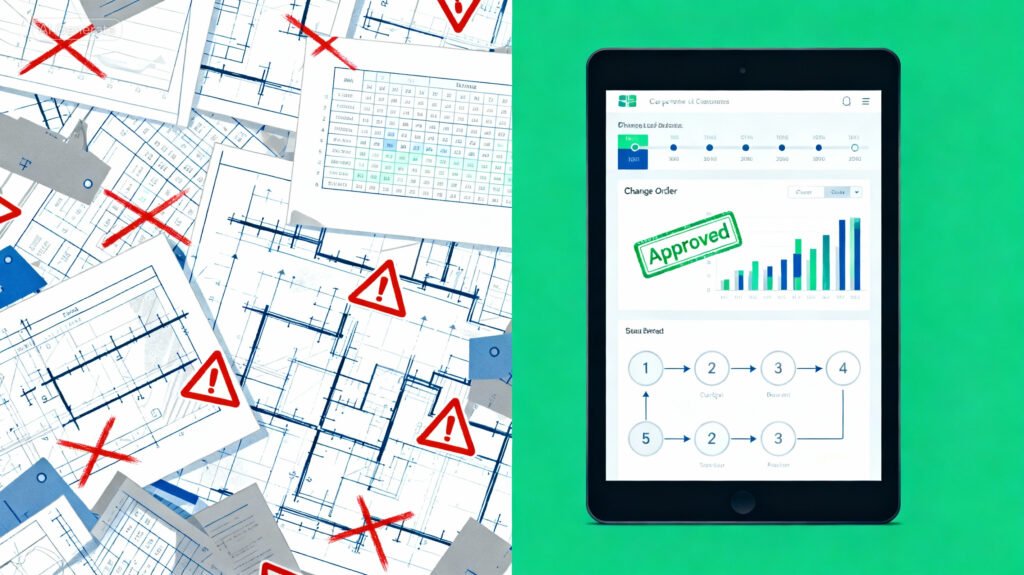
The 5-Step Change Management Process (THE OPERATIONAL CORE)
Here’s the meat: A non-negotiable, linear workflow for every change, from minor tweaks to major overhauls. This 5-step process following AGC’s change order best practices integrates documentation, analysis, and communication into a bulletproof system for change order management. Implement it religiously, and you’ll turn changes into controlled, billable events.
Step 1: Immediate Identification & Centralized Logging
The moment a potential change surfaces—log it. Delays here compound costs exponentially.
Mandate a single Change Order Log as your command center. Here’s a simple table template:
| CO # | Date Identified | Description | Trigger (e.g., Site Condition) | Status (Pending/Submitted/Approved) | Estimated Cost | Estimated Time Impact |
|---|---|---|---|---|---|---|
| 001 | MM/DD/YY | Add extra conduit | Owner request | Pending | $5,000 | +2 days |
The rule: “Log it the moment it’s identified.” Use mobile apps for field supers to input real-time, ensuring nothing slips through.
Step 2: Comprehensive Impact Analysis
Go beyond direct costs—quantify the full ripple effect to justify your pricing.
Calculate:
- Direct costs: Labor, materials, equipment.
- Indirect costs: Overhead allocation, insurance hikes.
- Cumulative impact: How this change affects others (e.g., stacking delays).
- Schedule delay costs: Extension of Time (EOT) via CPM analysis.
Introduce a simple Impact Matrix:
- Rows: Cost Categories (Direct, Indirect, Schedule)
- Columns: Low/Medium/High Impact
- Score each, then sum for a risk-adjusted estimate.
Actionable tool: Use formulas like Total Cost = Direct + (Indirect Rate x Duration) + (Daily Overhead x Days Delayed). This defends against owner pushback on “inflated” claims.
Step 3: Ironclad Documentation & Packaging
Your submission must be courtroom-ready—clear, comprehensive, and defensible.
Mandatory package contents:
- Narrative: Who, what, when, why—framed around contract clauses.
- Evidence: Photos, sketches, test reports.
- Itemized cost breakdown: Line-by-line with backups (quotes, timesheets).
- Revised CPM snippet: Showing before/after critical path.
Emphasize clarity: Use bullet points, bold totals, and executive summaries. This isn’t paperwork—it’s your negotiation ammunition.
Step 4: Formal Submission & Authorization
Submit promptly, then chase approvals aggressively.
Stress the golden rule: “No signature, no work.” If stalled, follow this protocol:
- Day 3: Polite email reminder.
- Day 7: Phone call to decision-maker.
- Day 10: Formal notice of potential claim.
Document every interaction to build a paper trail for escalation.
Step 5: Integration & Communication
Once approved, weave it in seamlessly.
Update budgets, schedules, and subcontracts immediately. Communicate via all-hands meetings or digital dashboards: “Team, CO #001 adds $5K and 2 days—here’s how it affects your trades.”
Key takeaway: This step closes the loop, preventing misalignments that spawn secondary disputes.
Master this 5-step process, and construction change orders become predictable revenue streams, not profit killers.
Negotiation & Conflict Resolution: The Human Element
Processes alone won’t win—enter the psychology of construction negotiation. Shift from adversarial haggling to collaborative problem-solving, preserving relationships for future bids.
Adopt the Panda Mindset: Externally calm and collaborative (like a panda’s gentle demeanor), internally firm and strategic on key terms (like its powerful bite). This disarms emotions, focusing talks on facts.
Evidence-Based Negotiation: Your Step 3 package is your strongest ally. Present changes as “shared challenges” with data: “Based on site photos and CPM, this adds 5 days—here’s the breakdown.” Turn disputes into factual debates: “What data suggests otherwise?”
Establish a Communication Protocol: Reinforce “Phone call before email” for difficult news. It humanizes issues and prevents misreads. Frame changes around owner benefits: “This upgrade ensures long-term durability, aligning with your occupancy goals.”
For deadlocks, deploy tactics:
- Bring in Subject Matter Experts (SMEs): Neutral engineers to validate impacts.
- Escalate strategically: To owner’s execs, emphasizing mutual project success.
- Offer compromises: E.g., phased payments or value engineering alternatives.
Bold mindset: View negotiation as partnership-building, not warfare. This resolves 80% of conflicts without lawyers.
Leveraging Technology: The Force Multiplier
Tech isn’t a luxury—it’s your edge in change order management, automating drudgery and providing irrefutable data.
Digital Reality Capture (3D Scanning, LiDAR): This is your “single source of truth” for site conditions. Scan baselines and changes to eliminate “he said/she said” over as-builts. Tools like Leica RTC360 capture discrepancies in minutes, turning hidden issues into documented facts.
Construction Management Software (Procore, Autodesk Build): Automates the 5-step process with workflows for logging, analysis, and approvals. It creates an immutable audit trail, real-time budget tracking, and alerts for stalled submissions. Pro tip: Integrate with CPM tools for auto-EOT calculations.
Automated Document Control: Use digital forms and templates to standardize packages, prevent version chaos, and ensure compliance. Platforms like Bluebeam Revu allow markups and e-signatures, slashing approval times by 50%.
Key insight: Tech turns reactive firefighting into proactive forecasting, spotting cumulative impacts before they balloon.
Frequently Asked Questions (FAQ)
Here are answers to common questions from construction pros on change order management and conflict resolution in construction.
1. How do I handle an owner who refuses to sign a change order but demands the work proceed?
Issue a Construction Change Directive (CCD) if contractually allowed, but document your protest in writing: “We proceed under directive but reserve rights for compensation.” Log costs meticulously and follow up weekly. If unresolved, escalate to mediation per contract.
2. What’s the biggest mistake contractors make in impact analysis?
Underestimating indirect and cumulative costs. Always include overhead, productivity loss, and ripple effects on other trades. Use the Impact Matrix to quantify—owners respect data over estimates.
3. Can I charge for changes caused by my own errors?
Rarely. If it’s your fault (e.g., poor workmanship), eat it to maintain goodwill. But if it’s an unforeseen condition or owner delay, bill it. Reference the Scope Baseline to prove it’s not your baseline responsibility.
4. How does technology help with small projects where budgets are tight?
Start free or low-cost: Google Sheets for logs, free LiDAR apps on smartphones for scans. Scale to Procore trials for automation. Even basic digital tools cut documentation time by 30%, paying for themselves in avoided disputes.
5. What if negotiations turn personal or heated?
Invoke the Panda Mindset—stay calm, redirect to facts: “Let’s focus on the data; how does this align with project goals?” Take a break if needed, or loop in a neutral SME. Document the exchange neutrally for records.
6. How often should I review the Change Order Log?
Weekly at minimum, during progress meetings. Flag high-risk items early. Quarterly, analyze trends (e.g., recurring design errors) to refine future contracts and contingency planning.
Conclusion: Building a Culture of Predictability
In wrapping up, a rigorous change management system transforms a perennial source of conflict into a process of professional collaboration. By embedding proactive prevention, the 5-step workflow, psychological savvy, and tech tools, you’ll master construction dispute avoidance and protect your margins.
Restate the core principle: Proactive systems protect profits and reputations, making changes controlled rather than chaotic.
Before your next project begins, audit your change order clause, set up your digital log, and commit to the rule: Document First. Implement this playbook, and watch your projects sail smoothly to success.
