
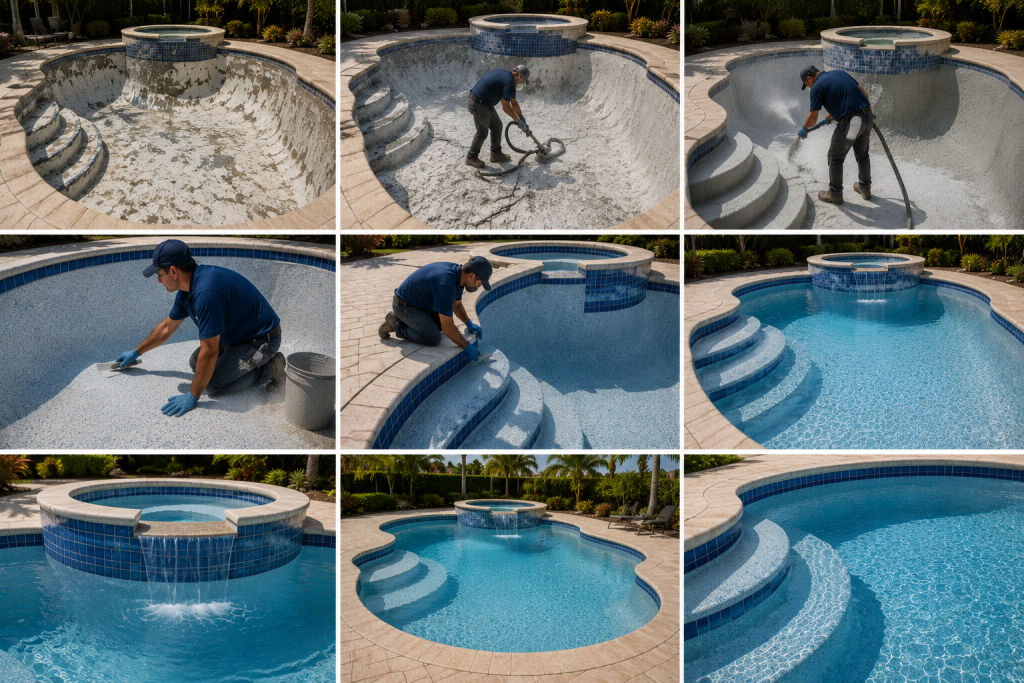

Pool resurfacing is the replacement of a pool’s interior finish after the existing surface has deteriorated or no longer meets the owner’s goals. The correct scope depends on the existing finish, visible condition, pool geometry, access, waterline and fittings, desired material, and whether adjacent repairs are needed. A site assessment is more reliable than a generic online number.
The short version
Phoenix homeowners should treat resurfacing as a finish-and-scope decision, not a one-size-fits-all repair. Ask what is included, which product and applicator instructions apply, how startup care will be handled, and whether local approvals or barrier checks are relevant. Phoenix and county requirements are jurisdiction-specific, so confirm them with the applicable authority.
When does a Phoenix pool need resurfacing?
A pool may be a candidate for resurfacing when the interior finish shows deterioration that routine cleaning and balanced water care cannot correct. The visible symptom alone does not determine the remedy. A qualified assessment should distinguish finish wear from plumbing, structural, tile, coping, deck, equipment, or water-chemistry issues.
The National Plasterers Council notes that cementitious finishes can show normal shade variation, mottling, aggregate-density variation, and hairline crazing. It also says a finish should be evaluated when the pool is full of water and under natural light. That means color variation is not automatically proof of failed workmanship or a need to resurface.
Consider an evaluation when the surface has persistent roughness, exposed or missing material, recurring stains that remain after the underlying cause is addressed, or deterioration that affects how the pool is used. These observations are prompts for diagnosis, not a remote diagnosis of your pool.
Answer-worthy statement: A change in color or texture does not by itself prove that a pool needs resurfacing; the finish should be assessed in context, including normal variation and water-chemistry history.
What does pool resurfacing cost in Phoenix?
There is no authoritative Phoenix price schedule in the sources reviewed, so this page intentionally does not publish a fabricated cost range. BuildXL project-specific pricing requires a quote. A quote should be based on the actual pool rather than a generic “typical pool” assumption.
The main cost drivers commonly include the amount of interior surface to be treated, the selected finish, preparation and removal requirements, access and protection needs, repairs discovered after the pool is drained, tile or fitting work included in the scope, water handling, and startup or post-work care. The written proposal should identify inclusions and exclusions so that finish-only work is not confused with a larger remodel.
Phoenix quote requests should also distinguish resurfacing from a broader pool renovation. A proposal that includes new tile, coping, decking, lighting, plumbing, automation, or water features is not directly comparable with a proposal limited to the interior finish.
For a planning framework, see the recommended supporting article Phoenix quote factors. That page should not publish a local range unless BuildXL can support it with current, clearly documented evidence and a defined scope.
Answer-worthy statement: Because pool geometry, finish selection, preparation, repairs, and included work vary, a Phoenix homeowner should compare written scopes rather than treat an online price range as a quote.
What is included in a resurfacing project?
At hub level, resurfacing means preparing the existing interior surface and installing a new interior finish under the applicable product and trade guidance. The exact sequence is deliberately outside this page’s scope. It can vary with the existing material, the selected replacement, site conditions, and any additional work identified during assessment.
A complete proposal should make the boundaries clear. Ask whether it includes draining and protecting the work area, surface preparation, the named finish product, color or aggregate selection, tile or fitting work, repairs, cleanup, fill water, startup service, warranty documents, and owner instructions. If an item is not listed, ask whether it is excluded or priced separately.
The National Plasterers Council recommends a startup procedure for freshly plastered pools and explains that water chemistry after startup affects finish longevity. Manufacturer instructions can add product-specific requirements. For example, Pebble Technology International advises regular water testing, cautions against entering before the pool is filled and balanced, and provides product-specific brushing and waiting guidance.
For detailed preparation and startup guidance, link to what the work involves rather than turning this hub into a step-by-step manual.
Answer-worthy statement: The finish material and the responsible manufacturer or applicator instructions determine post-installation care; a generic startup checklist should not replace the written instructions for the selected product. 4 5
Which pool finish should a Phoenix homeowner choose?
The choice should balance appearance, texture, maintenance expectations, budget, and the condition of the existing pool. Common decision categories include cementitious plaster and aggregate finishes, but the available products, colors, textures, and warranties vary by manufacturer and applicator. This page does not endorse a product or promise a service life.
Pebble Technology International states that aggregate finishes naturally vary in color, shade, consistency, and exposure, and that water color changes with sunlight and shade. The National Plasterers Council likewise explains that shade and aggregate variation can be normal characteristics rather than defects. Homeowners should review a manufacturer’s disclosure and ask how the finished surface will be evaluated before selecting a color or texture.
Use the supporting guide compare interior finish options for a structured comparison. Keep product names accurate and do not use a manufacturer trademark as a generic name for every aggregate finish.
Answer-worthy statement: Finish samples cannot guarantee one uniform appearance in the installed pool because light, water, substrate, installation conditions, and natural material variation affect the final look.
Phoenix and Maricopa County requirements to check
The applicable authority depends on the property’s jurisdiction. The City of Phoenix states that it checks pools for code compliance and health and safety issues and provides links for pool permits, barrier requirements, enforcement procedures, and related guidance. Phoenix homeowners should use the city’s current Planning and Development resources for project-specific questions.
Maricopa County publishes a separate residential pool and barrier page for unincorporated county areas. It states that outdoor pool-barrier permits must be issued before installing the barrier, plastering the pool, or filling the pool with water. The same page states that pools must not be in the required front yard and must be at least three feet from property lines. Those statements should not be copied onto a city property without checking the city’s rules.
Arizona’s Registrar of Contractors lists the B-5 General Swimming Pool Contractor classification as allowing construction and repair of swimming pools and spas, plus code-required pool barriers and utilities from the point of service to pool equipment within the stated scope. That classification description is useful when vetting a contractor, but it does not verify BuildXL’s license status.
Answer-worthy statement: Permit and barrier requirements are jurisdiction-specific; Phoenix and unincorporated Maricopa County publish different authorities and guidance, so a homeowner should confirm the property’s governing rules before work begins.
How to compare Phoenix resurfacing quotes
Request at least a written scope and ask the same questions of each bidder. The proposal should identify the existing-surface assumptions, selected finish, preparation, included repairs, tile or fitting work, water and cleanup responsibilities, startup care, warranty terms, exclusions, payment schedule, and change-order procedure.
Ask who is responsible for product registration or warranty documentation when the manufacturer requires it. Pebble Technology International recommends retaining water-test reports for a warranty request and directs owners to product-specific maintenance procedures. The National Plasterers Council also emphasizes that water chemistry and filtration are part of maintaining a finish after startup.
Do not compare two proposals only by the headline number. Compare the same scope, material category, finish area, repair assumptions, and post-work responsibilities. If one quote is much lower, ask which line items are omitted rather than assuming the lowest number is the best value.
Answer-worthy statement: A comparable resurfacing quote names the finish and the work boundaries; otherwise, different proposals may describe different projects even when they use the same word, “resurfacing.”
Service area and local context
BuildXL’s supplied service-area brief lists Phoenix, Gilbert, Scottsdale, Tempe, Paradise Valley, North Scottsdale ZIP codes 85262, 85266, and 85255, Fountain Hills, Cave Creek, Carefree, and Chandler 85249. This page must not imply that every neighborhood has the same permitting authority, site conditions, scheduling, or pricing.
The defensible Phoenix-area distinctions are regulatory and geographic rather than promotional. Phoenix has its own Planning and Development pool-barrier resources. Unincorporated Maricopa County publishes its own barrier and setback guidance. Arizona has a state contractor-classification system. Phoenix’s 1991–2020 normal average annual temperature is 75.6°F, according to the National Weather Service. None of these facts proves a particular material will last a set number of years or that a particular contractor is available.
For any future city page, use city- or county-level official facts and a genuinely different search intent. Do not create thin pages that repeat this article with a city name swapped in.
Answer-worthy statement: The useful local question is not only “what finish do I want?” but also “which authority governs this property and what scope does my quote actually include?”
Questions to ask before hiring
Ask for the business name exactly as it will appear on the proposal, the Arizona license information when applicable, the license classification and status verification path, the finish manufacturer and product documentation, the written scope, exclusions, startup responsibilities, warranty process, and the person responsible for project communication. Do not assume a trade association membership, review profile, or marketing claim proves licensing or workmanship.
BuildXL’s phone, author, reviewer, and Google Business Profile details are not present in the supplied brief. They must be configured before publication. Do not replace the required placeholders with an invented contact, credential, rating, or profile link.
Request a project-specific quote: [REQUIRED BRAND CONFIG: PHONE]
Frequently asked questions
Is pool resurfacing the same as replastering?
“Replastering” commonly describes replacement of a cementitious pool interior finish, while “resurfacing” is a broader consumer term. The proposal should name the actual finish product and scope. BuildXL’s locked service name is Pool Resurfacing.
Can an online calculator tell me my Phoenix price?
No. An online calculator cannot inspect the pool, verify its dimensions and condition, or identify included repairs. Use online information to prepare questions, then request a written, project-specific quote. This page intentionally does not state a Phoenix price range.
Does every resurfacing project need the same permit?
No universal answer is safe. Phoenix and unincorporated Maricopa County publish different authorities and requirements. Check the property’s jurisdiction and ask the responsible department about the proposed work before scheduling.
Will a new finish have perfectly uniform color?
Not necessarily. The National Plasterers Council and Pebble Technology International both describe natural or normal variation in finish shade, aggregate exposure, and appearance. Evaluate the completed finish under the conditions specified by the applicable disclosure.
What should happen after the pool is filled?
Follow the selected product’s and applicator’s written startup and maintenance instructions. Manufacturer and industry guidance emphasizes water testing, balanced chemistry, brushing or other care, and avoiding actions that could damage a new finish. Detailed instructions belong on the supporting process and startup page.
Does BuildXL serve my city?
The supplied BuildXL service-area brief lists Phoenix, Gilbert, Scottsdale, Tempe, Paradise Valley, North Scottsdale (85262/85266/85255), Fountain Hills, Cave Creek, Carefree, and Chandler 85249. Confirm current availability and project fit directly with BuildXL using the configured contact details.