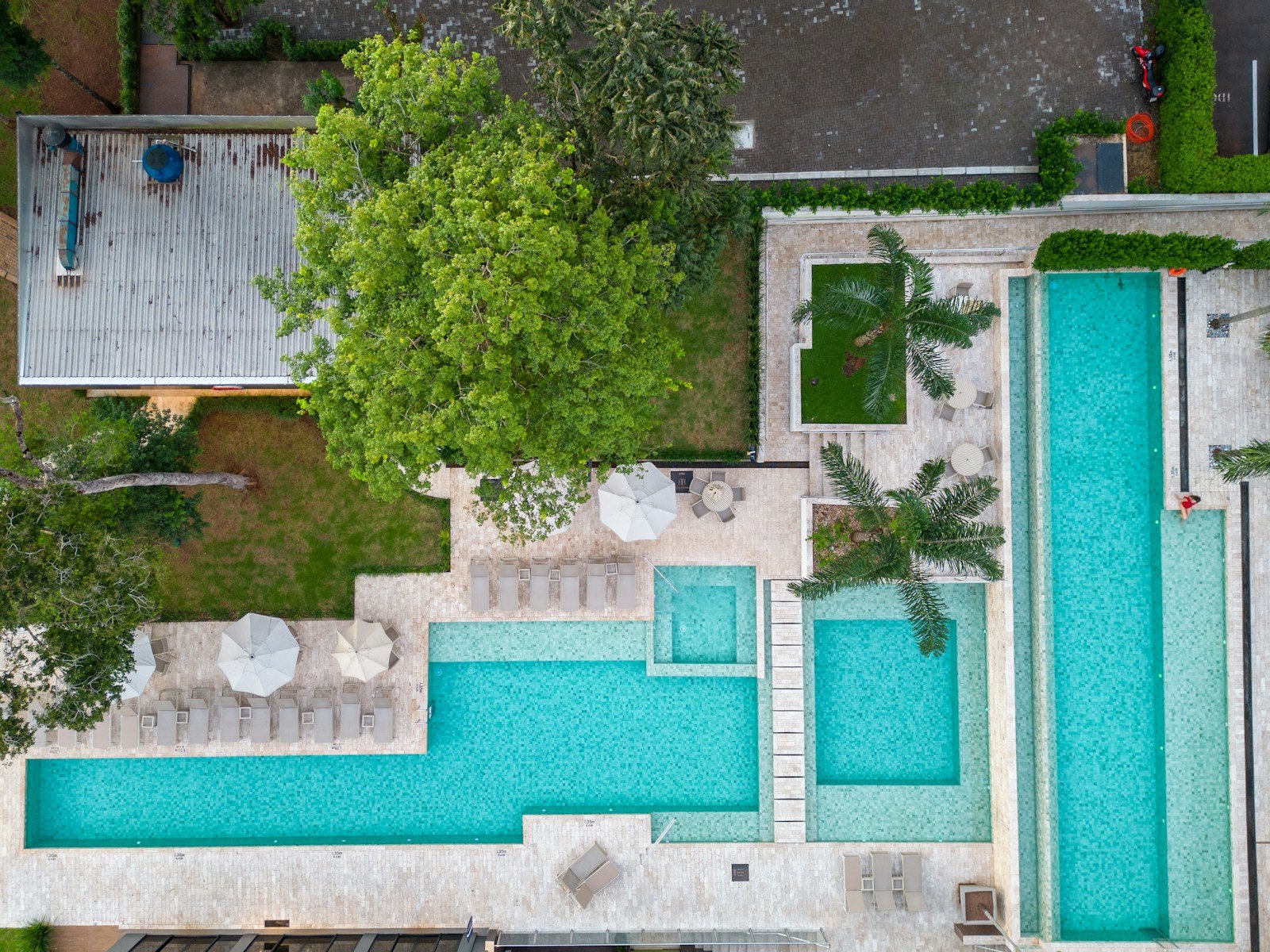
Building a 1,500 square foot swimming pool is a significant investment that transforms a property into a personal oasis. However, the process involves far more than digging a hole and filling it with water. A complete pool construction project encompasses multiple phases: earthworks and foundation, structural concrete work, finishing and tiling, plumbing, mechanical systems, heating, and the pool cover. Each phase requires careful planning, specialized labor, quality materials, and adherence to safety standards.
This comprehensive guide walks you through every step of constructing a 1,500 sq. ft. swimming pool, providing detailed insights into the processes, materials, equipment, and costs involved. Whether you are a homeowner planning a project or a construction professional seeking a structured overview, this article serves as a complete resource.
Table of Contents
Phase 1: Planning and Permitting
Before any excavation begins, thorough planning is essential.
Site Assessment
- Soil Testing: A geotechnical analysis determines soil composition, bearing capacity, and water table levels. This influences foundation design and drainage requirements.
- Topography: The slope of the land affects excavation complexity and drainage planning.
- Utility Location: Underground gas, electric, water, and sewer lines must be identified and marked to avoid damage during excavation.
Permitting
- Building Permit: Required for structural construction.
- Electrical Permit: For pumps, lighting, and heating systems.
- Plumbing Permit: For water supply, drainage, and circulation systems.
- Safety Compliance: Local codes may require specific safety features such as fencing, alarms, or anti-entrapment drain covers.
Phase 2: Earthworks and Foundation
This phase establishes the stable base upon which the entire pool structure rests. The quality of earthworks directly impacts the pool’s long-term integrity.
Step 1: Site Preparation and Excavation
The pool area is marked, and excavation begins. The goal is to achieve the precise dimensions and depth required by the pool design.
Equipment Used:
- Bulldozers (80 HP / 59 kW)
- Single-bucket diesel excavators (0.65 m³ bucket capacity)
- Watering machines (7.8 CY tank capacity)
Process:
- Clearing: Vegetation, topsoil, and debris are removed from the site.
- Leveling Slopes: The embankment slopes around the excavation are leveled to create stable, uniform inclines. The recommended slope ratio is 1:2 to 1:3 to prevent erosion. Compaction is performed in layers using tamping plates.
- Excavating the Pit: The excavator digs the pool pit to the planned depth, removing approximately 278 cubic yards of earth for a 1,500 sq. ft. pool with a 5-foot average depth.
Cost Context: Excavation and initial earthworks cost approximately $228.84 per 1,000 sq. ft. of work volume for larger excavations (over 1,076 sq. ft.). For a 1,500 sq. ft. pool, this amounts to roughly $343.26.
Step 2: Foundation Soil Preparation
Once the pit is excavated, the soil at the bottom must be conditioned to achieve optimal compaction.
Equipment Used:
- Single-bucket diesel excavators
- Drilling and crane machines (drilling depth up to 9.84 ft)
- Watering machines
Process:
- Drilling Moisture Holes: To ensure water penetrates deep into the subgrade, holes are drilled in a grid pattern up to 9.84 ft (3 meters) deep. This allows for uniform moisture distribution.
- Moistening the Soil: Water is evenly applied across the foundation area using watering machines or spray systems. The soil should be uniformly moist but not saturated. After application, the soil is allowed to rest for several hours to allow full penetration.
Key Materials: Water (approximately 4.01 CY per 1,000 sq. ft. of work volume).
Step 3: Soil Compaction
Compaction creates a dense, stable base that prevents future settling and cracking.
Equipment Used:
- Tamping plates with 6.56 ft (2 m) diameter
- Self-propelled compaction equipment
Process:
- The tamping plate is moved across the excavation bottom in parallel tracks.
- For standard compaction, each track receives 10 to 14 blows. For very large excavations (over 1,076 sq. ft.), a reduced pattern of 6 to 9 blows per track is sometimes acceptable.
- Compaction is performed in layers to ensure uniform density without voids.
- Regular testing verifies that the soil has reached the required load-bearing capacity.
Cost Context: Soil compaction costs range from $228.84 to $376.11 per 1,000 sq. ft. depending on the compaction intensity and area size.
Step 4: Control Pits and Foundation Concrete
Control pits are excavated, inspected, and filled with concrete to verify foundation integrity.
Equipment Used:
- Single-bucket excavators
- Drilling and crane machines
Materials:
- Heavy concrete mixes (B10, B12.5 class with water resistance W2-W4)
Process:
- Small control pits are dug to inspect soil layers and compaction quality.
- After inspection, pits are cleaned and filled with concrete.
- Concrete is compacted to eliminate air pockets, ensuring a solid, uniform fill.
Phase 3: Pool Structure – Concrete Shell
With the foundation complete, the focus shifts to constructing the pool’s structural shell. This is the most material-intensive phase.
Step 1: Formwork Construction
Formwork serves as the mold that shapes the concrete walls and floor.
Equipment Used:
- Mobile cranes (17.64-ton capacity)
- Flatbed trucks
- Circular saws, drills
Materials:
- Edged softwood timber boards
- Construction nails
- Bolts with nuts and washers
- Electricity
Process:
- Manufacturing Formwork Panels: Wooden panels are cut to precise dimensions according to the pool design. Panels are assembled using nails and bolts.
- Manufacturing Braces and Struts: Timber supports are cut and assembled to hold formwork panels against the pressure of wet concrete.
- Delivery and Assembly: Formwork elements are transported to the site, assembled within the excavation, aligned, leveled, and securely braced. All joints are checked for tightness to prevent concrete leakage.
Cost Context: Wooden formwork costs range from $89.35 to $113.27 per 100 sq. ft. depending on excavation width and base thickness. For a 1,500 sq. ft. pool base, this costs approximately $1,340.25.
Step 2: Reinforcement Installation
Steel reinforcement (rebar) provides tensile strength, preventing cracks and enabling the structure to withstand hydrostatic pressure.
Equipment Used:
- Tower cranes (8.82–12.5 ton capacity)
- Welding machines (manual arc welding up to 350 A)
- Rebar cutters and benders
Materials:
- Rebar (class A500C, various diameters)
- Binding wire
- Bolts
Process:
- Cutting: Rebar is cut to lengths specified in the structural engineering plans.
- Fixing the Cage: Rebar is assembled into a grid (cage) within the formwork. Horizontal and vertical bars are tied with wire or welded.
- Ensuring Proper Cover: Plastic or concrete spacers are used to position rebar correctly within the formwork, providing the necessary concrete cover for corrosion protection (typically 1.5 to 3 inches).
Cost Context: Rebar costs approximately $1,037.71 per ton. A typical pool of this size requires about 6.58 tons of rebar per 100 cubic yards of concrete, costing roughly $6,828.13 per 100 CY.
Step 3: Concreting the Shell
Concrete is poured and consolidated to form the solid pool structure.
Equipment Used:
- Tower cranes
- Trailer-mounted concrete pumps (78.5 CY/h capacity)
- Hydraulic concrete distribution booms (for curved walls)
- Deep vibrators
Materials:
- Heavy concrete mix (B10, B12.5 class, with water resistance W2-W4 and frost resistance F50-F100)
Process:
- Preparation: Formwork and reinforcement are inspected. Concrete mix is prepared with the correct water-cement ratio for workability and strength.
- Pouring: Concrete is pumped into the formwork. For walls, it is poured in layers (typically 18-24 inches per lift) to prevent segregation. For curved walls, a distribution boom ensures even placement.
- Vibration: A deep vibrator is inserted into the fresh concrete to eliminate air bubbles, ensuring it fully encapsulates the rebar and fills all formwork corners.
- Finishing: The top surface of the pool floor is screeded and troweled to a smooth, even finish.
Cost Context: Reinforced concrete wall construction costs approximately $23,794.72 per 100 cubic yards. For a 1,500 sq. ft. pool with a 5-foot average depth (278 CY), the concrete structure costs approximately $66,149.32. Concreting curved walls is a specialized process costing $22,909.37 per 100 CY.
Step 4: Curing and Formwork Removal
After concreting, the structure must cure properly to achieve maximum strength, and the formwork is removed.
Equipment Used:
- Tower cranes
- Hand tools
Materials:
- Geotextile (non-woven polyester, needle-punched)
- Curing compounds
- Water
Process:
- Curing: The concrete surface is covered with geotextile or a curing compound and kept moist for 7 to 14 days. This prevents rapid drying, which can cause cracking and reduced strength.
- Cleaning and Lubricating Formwork: Once the concrete has set sufficiently, formwork panels are carefully dismantled. They are cleaned of concrete residue and lubricated with a release agent (such as emulsol) to prepare for future use and protect the finished concrete surface.
- Dismantling: Formwork and supporting structures are systematically removed, starting from the top and working downward, ensuring the new concrete walls are not damaged.
Phase 4: Finishing and Tiling
With the structural shell complete, the interior surface is finished to create a smooth, waterproof, and aesthetically pleasing pool.
Step 1: Surface Preparation
Process:
- Concrete walls and floor are inspected for imperfections, honeycombing, or protrusions.
- High spots are ground down using diamond grinders.
- Small voids and cracks are filled with a cementitious repair mortar.
- The entire surface is cleaned to remove dust, oil, and debris.
Key Materials: Diamond grinding tools, repair mortar, pressure washer.
Step 2: Base Coat / Plastering
A smooth, waterproof base coat is applied to create a uniform substrate for tiling or the final finish.
Process:
- A polymer-modified cement render (often a mixture of white cement and marble dust) is applied by hand using trowels.
- The plaster is applied in one or two coats, achieving a consistent thickness of approximately 3/8 to 1/2 inch.
- The surface is floated to a smooth, even finish and allowed to cure.
Key Materials: White cement, marble dust, polymer additives, water.
Work Time: Highly labor-intensive, requiring skilled plasterers. Typically takes 2-4 days for a pool of this size.
Step 3: Tile Installation
Tiling is the preferred final finish for its durability, ease of cleaning, and aesthetic versatility.
Process:
- Adhesive Application: A waterproof thin-set mortar or epoxy adhesive is applied to the prepared surface using a notched trowel.
- Tile Placement: Ceramic, porcelain, glass, or natural stone tiles are carefully placed. Waterline tiles (a decorative band at the water’s edge) are a common feature. Tile spacers ensure even gaps.
- Cutting: Tiles are cut to fit around skimmers, return jets, lights, and stairs using wet saws or tile cutters.
- Grouting: Once the adhesive cures (typically 24-48 hours), the gaps between tiles are filled with waterproof epoxy or cementitious grout.
- Sealing: Grout is sealed to prevent staining and water absorption.
Key Materials:
- Pool-grade tiles ($5–$30+ per sq. ft. depending on material)
- Waterproof thin-set adhesive ($30–$60 per bag)
- Epoxy grout ($50–$100 per gallon)
- Tile spacers, cutters, wet saw
Cost Context: Tiling can range from $10 to $30+ per square foot installed, depending on tile quality and complexity. For a 1,500 sq. ft. pool, tiling the floor and walls could cost $15,000 to $45,000+.
Step 4: Alternative Finishes
If tiling is not preferred, alternative finishes are available:
| Finish Type | Description | Cost Context | Durability |
|---|---|---|---|
| Pebble / Quartz | Plaster-based finish mixed with small pebbles or quartz aggregates. Applied by hand and troweled. | $7–$15 per sq. ft. | 10–15 years |
| Marcite (White Plaster) | Traditional cement-based plaster finish. Smooth, classic appearance. | $4–$8 per sq. ft. | 5–10 years |
| Epoxy Paint | Specialized pool paint applied over prepared concrete. Least durable option. | $2–$4 per sq. ft. | 2–5 years |
Phase 5: Plumbing
The plumbing system circulates water to and from the filtration and treatment equipment.
Step 1: Main Drain and Skimmers
Main Drain:
- Located at the deepest point of the pool floor.
- Must be anti-entrapment compliant (usually dual drains or a safety vacuum release system – SVRS).
- Connected to the suction side of the pump with 2-inch PVC pipe.
Skimmers:
- Installed at the waterline within the pool wall (typically 2-3 units for a 1,500 sq. ft. pool).
- Draw water from the surface, removing floating debris before it sinks.
- Each skimmer is plumbed separately to the pump with 1.5- or 2-inch PVC pipe.
Step 2: Return Lines
Process:
- PVC pipes run from the mechanical equipment (filter/heater) back to the pool.
- Water returns through directional jets (return inlets) installed in the pool walls.
- Returns are positioned to create optimal circulation patterns, preventing dead spots and ensuring even chemical distribution.
Materials: Schedule 40 or Schedule 80 PVC pipe, PVC fittings, return inlets.
Step 3: Plumbing Trenching and Installation
Process:
- Trenches are dug from the pool to the mechanical equipment pad before decking or landscaping.
- PVC pipes are laid in trenches, glued with solvent cement, and pressure-tested for leaks.
- Backfill is carefully placed and compacted around pipes to prevent settling.
Step 4: Valves and Fittings
At the equipment pad, a manifold of valves controls water flow:
| Component | Function |
|---|---|
| Check Valve | Prevents water from flowing backward into the pool when the pump is off. |
| Diverter Valve | Allows control of water flow to different features (e.g., spa, waterfall, returns). |
| Union | Enables easy disconnection of equipment for maintenance or replacement. |
Phase 6: Mechanical Systems (Filtration and Circulation)
This is the heart of the pool’s water treatment system, ensuring water remains clean, clear, and safe.
Step 1: Circulation Pump
Function: The pump pulls water from skimmers and main drain, pushes it through the filter and heater, and returns it to the pool.
Key Considerations:
- Variable-Speed Pumps: Highly recommended for energy efficiency. They can reduce electricity consumption by 50-80% compared to single-speed pumps.
- Sizing: A pump should be sized to turn over the entire pool volume in 8-10 hours. For a 1,500 sq. ft. pool with an average depth of 5 ft (approximately 56,000 gallons), a pump with a flow rate of 70-90 gallons per minute is appropriate.
Cost Context: Variable-speed pumps range from $800 to $2,500 installed.
Step 2: Filtration System
Function: Removes debris, dirt, and small particles from the water.
| Filter Type | Description | Filtration Rating | Maintenance | Cost Context |
|---|---|---|---|---|
| Sand Filter | Water passes through a bed of silica sand. Backwashing cleans the filter. | 20-40 microns | Backwash every 2-4 weeks; replace sand every 5-7 years. | $500–$1,200 |
| Cartridge Filter | Water passes through pleated polyester cartridges. No backwashing required. | 10-15 microns | Hose off cartridges every 3-6 months; replace every 1-3 years. | $600–$1,500 |
| Diatomaceous Earth (DE) Filter | Water passes through grids coated with DE powder. Finest filtration available. | 2-5 microns | Backwash and add DE powder; complete disassembly and cleaning 1-2 times per year. | $1,000–$2,000 |
Step 3: Sanitization System
Function: Kills bacteria, algae, and other microorganisms to maintain safe swimming conditions.
| System Type | Description | Pros | Cons | Cost Context |
|---|---|---|---|---|
| Salt Chlorine Generator | Converts dissolved salt (3,000-4,000 ppm) into chlorine through electrolysis. | Softer-feeling water, less handling of chemicals, consistent sanitation. | Higher upfront cost, salt cells require replacement every 3-7 years. | $1,500–$3,000 |
| Chlorine Feeder | Automated erosion feeder for chlorine tablets (trichlor). | Simple, reliable, low upfront cost. | Requires regular tablet refills; can over-chlorinate if not monitored. | $200–$600 |
| Ozone / UV System | Ozone or UV light oxidizes contaminants, reducing chlorine demand. | Reduces chlorine usage by 50-90%, eliminates combined chlorine (chloramines). | Higher upfront cost; used as a supplement, not a standalone sanitizer. | $1,500–$4,000 |
Phase 7: Pool Heating
Heating extends the swimming season and ensures water remains at a comfortable temperature.
Step 1: Heater Selection
| Type | How It Works | Best For | Efficiency | Upfront Cost | Operating Cost |
|---|---|---|---|---|---|
| Gas Heater | Burns natural gas or propane to heat water passing through a copper or titanium heat exchanger. | Spas, pools needing rapid heating, cooler climates. | 80-85% | $1,500–$4,000 | High |
| Heat Pump | Uses electricity to capture heat from ambient air and transfer it to pool water. | Pools needing consistent, sustained heating in mild to warm climates. | 500-600% (COP 5-6) | $3,000–$6,000 | Low |
| Solar Heater | Circulates water through solar panels (usually roof-mounted) to capture heat from the sun. | Pools in sunny climates with ample roof space. | Varies with sunlight | $4,000–$8,000 (for panels) | Zero |
Step 2: Heater Sizing
For a 1,500 sq. ft. pool (approximately 56,000 gallons), a heater should be sized to raise water temperature by 1-1.5 degrees Fahrenheit per hour:
- Gas Heater: 300,000–400,000 BTUs
- Heat Pump: 120,000–150,000 BTUs
Step 3: Installation
- The heater is plumbed into the return line after the filter and before the return jets.
- Gas heaters require a dedicated gas line and proper ventilation.
- Heat pumps require electrical connections (typically 220V, 50-60 amps).
- A bypass valve allows water to bypass the heater when it is not in use.
Phase 8: Pool Cover
A pool cover is an essential component for safety, energy conservation, and maintenance.
Step 1: Types of Pool Covers
| Type | Primary Function | Key Features | Typical Cost (for 1,500 sq. ft.) |
|---|---|---|---|
| Safety Cover | Prevents accidental entry by children or pets. | Sturdy mesh or solid cover anchored into the deck. ASTM-compliant, can support significant weight. | $3,000–$7,000 |
| Solar Cover (Bubble Cover) | Reduces evaporation and passively warms water. | Lightweight, bubble-wrap-like cover that floats on water. Reduces evaporation by 90%+. | $300–$800 |
| Automatic Retractable Cover | Convenience, safety, and energy efficiency. | Motorized cover rolls on/off a reel at the touch of a button. Combines safety and solar benefits. | $10,000–$20,000 |
Step 2: Key Considerations
- Safety: If children or pets are present, an ASTM-compliant safety cover is strongly recommended.
- Energy Savings: A pool cover is the single most effective way to reduce heating costs by preventing evaporative heat loss (which accounts for 70-80% of heat loss).
- Maintenance: A cover keeps leaves, dirt, and debris out of the pool, reducing cleaning time and chemical consumption.
Phase 9: Decking and Landscaping
While not part of the pool structure itself, decking and landscaping are essential for safety, aesthetics, and functionality.
Decking
Materials:
- Poured Concrete: Durable, customizable, moderate cost. ($8–$15 per sq. ft.)
- Pavers: Aesthetic, easy to repair, wide variety of styles. ($15–$30 per sq. ft.)
- Travertine / Natural Stone: High-end appearance, cool underfoot. ($20–$50 per sq. ft.)
Key Features:
- Non-slip surface for safety.
- Adequate drainage to direct water away from the pool.
- Expansion joints to prevent cracking.
Landscaping
- Privacy: Fencing, hedges, or walls provide privacy and security.
- Drainage: Proper grading prevents runoff from entering the pool.
- Aesthetics: Plants, lighting, and hardscaping enhance the pool area.
Phase 10: Electrical and Lighting
Proper electrical work ensures safety, functionality, and ambiance.
Pool Lighting
- LED Lights: Energy-efficient, long-lasting, available in various colors. Installed in the pool wall (nicheless or niche-mounted).
- Fiber Optic Lighting: Safe (no electricity in water), creates dramatic effects.
- Perimeter Lighting: Lighting around the deck for safety and ambiance.
Electrical Components
- Sub-Panel: A dedicated electrical sub-panel is installed near the equipment pad, typically 100-200 amps.
- Grounding and Bonding: All metal components (handrails, ladders, lights, pumps) are bonded to prevent electrical shock.
- GFCI Protection: All circuits must be GFCI-protected.
- Compliance: Work must meet National Electrical Code (NEC) Article 680 requirements for pools.
Cost Summary Table
The following table summarizes the estimated costs for constructing a complete 1,500 sq. ft. swimming pool, including all phases.
| Phase | Work Item | Unit | Cost per Unit | Quantity for 1,500 SF | Estimated Cost |
|---|---|---|---|---|---|
| Earthworks | Excavation and Soil Compaction | 1,000 SF | $228.84 | 1.5 | $343.26 |
| Structure | Wooden Formwork for Base | 100 SF | $89.35 | 15.0 | $1,340.25 |
| Structure | Reinforced Concrete Walls (278 CY) | 100 CY | $23,794.72 | 2.78 | $66,149.32 |
| Finishing | Tiling (Floor and Walls) | SF | $15.00 (avg.) | 2,500* | $37,500.00 |
| Plumbing | PVC Pipes, Fittings, Valves | Lump Sum | — | — | $4,000–$6,000 |
| Mechanical | Pump, Filter, Sanitizer | Lump Sum | — | — | $4,000–$8,000 |
| Heating | Heat Pump or Gas Heater | Lump Sum | — | — | $4,000–$8,000 |
| Cover | Safety Cover or Automatic Cover | Lump Sum | — | — | $4,000–$15,000 |
| Decking | Concrete or Pavers (800 SF) | SF | $15.00 | 800 | $12,000.00 |
| Electrical | Sub-panel, Lighting, Bonding | Lump Sum | — | — | $3,000–$6,000 |
| Permits & Engineering | — | Lump Sum | — | — | $2,000–$5,000 |
| Contingency | 15% for Unexpected Issues | — | — | — | $15,000–$25,000 |
| Total Estimated Cost | $150,000–$200,000 |
*Note: The tiling quantity (2,500 SF) is an estimate based on a 1,500 SF floor area plus approximately 1,000 SF of wall area (assuming an average wall height of 4 feet and a perimeter of 200 linear feet).
Key Takeaways
Constructing a 1,500 sq. ft. swimming pool is a complex, multi-phase project that requires careful planning, skilled labor, and a substantial financial investment. The process begins with earthworks and foundation—the critical first step that ensures long-term structural integrity. The concrete shell then forms the pool’s shape and strength, followed by finishing and tiling that create the final interior surface.
Beyond the structural work, the pool must be equipped with plumbing, mechanical systems (pump, filter, sanitizer), and heating to make it functional and enjoyable. A pool cover adds safety and energy efficiency, while decking, landscaping, and electrical work complete the project.
Total costs for a fully finished 1,500 sq. ft. pool typically range from $150,000 to $200,000, depending on material choices, site conditions, and the complexity of features such as curved walls, automation, and premium finishes. By understanding each phase of construction, homeowners and builders can plan effectively, budget accurately, and ensure a successful project that provides years of enjoyment.